
Martial Arts for Preschoolers Isn't About Fighting. It's About Building the Foundation.
When some parents hear the words "martial arts for preschoolers," they immediately picture fighting.
Why would a four-year-old need to learn how to fight?
But walk into a great preschool martial arts class and you'll quickly realize something:
The fighting isn't really the point.
At this age, martial arts is about building the skills that come before the techniques.
Listening.
Balance.
Coordination.
Confidence.
Taking turns.
Following directions.
Working with other children.
Learning how to control their bodies.
These might seem like small things.
But they're building a foundation that can benefit a child for years.
Before They Can Learn Jiu-Jitsu, They Have to Learn How to Learn
Imagine trying to teach a complicated Jiu-Jitsu technique to a preschooler.
Before they can understand where their hands and feet need to go, they need something much more basic.
They have to listen.
They have to watch.
They have to remember instructions.
Then they have to try.
That's why a children's martial arts class might sometimes look more like play than serious training.
The children might be jumping.
Crawling.
Balancing.
Running through an obstacle.
Playing a game.
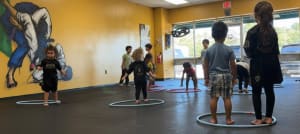
Standing inside a hoop.
But underneath all that fun, something important is happening.
They're learning how to learn.
Kids Need to Move
Young children weren't designed to spend their entire day sitting still.
They need movement.
They need to discover what their bodies can do.
Run.
Jump.
Balance.
Crawl.
Change direction.
Fall safely.
Get back up.
Martial arts gives children a structured environment where movement has a purpose.
They're having fun, but they're also developing coordination and body awareness.
And those basic physical skills become the foundation for more advanced movements later.
They're Learning to Follow Instructions
Sometimes the biggest victory in a preschool martial arts class isn't a perfect technique.
It's a child hearing:
"Everyone stand inside your circle."
And doing it.
Then waiting.
Then listening for the next instruction.
That may not look impressive from the sidelines.
But parents understand how important it is.
Children are learning that when the instructor speaks, they need to listen.
They're learning that there is a time to move and a time to stop.
A time to play and a time to pay attention.
Those are skills that can help them far beyond the martial arts academy.
They're Learning How to Be Part of a Group
For young children, being part of a class is itself a learning experience.
They don't always get to go first.
Sometimes they have to wait.
Sometimes another child gets the instructor's attention.
Sometimes they have to work with a partner.
Sometimes they have to encourage someone else.
They're beginning to understand something important:
The class isn't only about me.
That's the beginning of teamwork.
Confidence Starts With Small Victories
Confidence doesn't have to begin with something dramatic.
For a preschooler, confidence might begin with completing an activity they were nervous to try.
Maybe they couldn't balance the first time.
Maybe they were afraid to participate.
Maybe they wanted Mom or Dad beside them.
Then they try.
And eventually they do it.
The smile afterward tells you everything.
"I did it!"
Stack enough of those little victories together and a child begins developing a powerful belief:
"I can learn new things."
Discipline Doesn't Have to Mean Taking the Fun Away
Children should have fun.
Especially young children.
A great preschool martial arts program doesn't try to turn four-year-olds into miniature adults.
Instead, good instruction uses activities children enjoy to begin teaching bigger lessons.
Listen.
Wait.
Try.
Move.
Work together.
Finish what you started.
Try again when something doesn't work.
That's discipline at an age-appropriate level.
Fun and structure don't have to be opposites.
We're Building the Foundation at Jewel JiuJitsu
At Jewel JiuJitsu in Fayetteville, North Carolina, our youngest students don't need to walk through the doors already knowing martial arts.
That's why they're here.
We want to help them develop the foundation.
Coordination.
Listening.
Confidence.
Discipline.
Teamwork.
Movement.
And eventually, Jiu-Jitsu.
Parents may see children jumping through hoops, playing games, moving around the mats, and having fun.
But look a little closer.
They're learning how to listen.
They're learning how to move.
They're learning how to participate.
They're learning how to overcome small challenges.
They're learning how to become students.
Martial arts for preschoolers isn't about turning little kids into fighters.
It's about helping build the foundation for the people they're becoming.
Train Together. Grow Together.
Learn more at Jewel JiuJitsu or explore our Adult Brazilian Jiu-Jitsu Program, Kids Martial Arts Program, Homeschool Jiu-Jitsu Program, Teen and Preschool Jiu-Jitsu Program, and Women's Brazilian Jiu-Jitsu Program.