
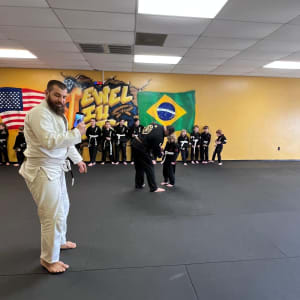
The 30-Day Beginner Plan
What to Do (and Not Do) in Your First Month of BJJ in Fayetteville, NC (Jewel JiuJitsu)
Starting Brazilian Jiu-Jitsu can feel like drinking from a firehose. New positions. New vocabulary. New body movements. New people. New “rules” you didn’t even know existed.
So if you’re thinking, “I want to start, but I don’t want to look dumb,” or “I started and I feel lost,” you’re normal.
This post is your simple 30-day beginner plan—a clear path for what to focus on in your first month so you progress faster, stay safer, and actually enjoy training.
If you’re in Fayetteville, NC, you can start your journey at Jewel JiuJitsu here:
https://jeweljj.com/
Brazilian Jiu-Jitsu program: https://jeweljj.com/classes/Brazilian-Jiu-Jitsu
For families:
Teen program: https://jeweljj.com/classes/Teen-Jiu-Jitsu
Kids Jiu-Jitsu / Kids Martial Arts: https://jewelbjj.com/page/kids-martial-arts
Jewel BJJ home: https://jewelbjj.com/
The goal of your first 30 days (and what most beginners get wrong)
A lot of beginners think the goal is to “win rounds,” submit people, or prove they belong.
But your real goal in the first month is simpler and more important:
You’re building survival, movement, and habits.
If you can learn how to stay calm, stay safe, move correctly, and understand the basic positions, you’ll improve quickly. If you skip that and try to roll like you’re in a fight, you’ll gas out, get frustrated, and feel like you’re “not good at BJJ” (even though you’re just new).
Week 1: Learn how to survive and understand what you’re looking at
Your first week is about getting familiar. BJJ will feel chaotic at first, so you need anchors—basic things you can recognize and repeat.
In week one, focus on understanding the major positions. You don’t need to master them, but you should start recognizing them. When people say “guard,” “side control,” “mount,” or “back control,” those words should slowly start to mean something.
Your main focus should be survival: learning how to protect yourself, how to tap early, how to breathe, and how to avoid panic. This is the week you learn that you’re not trying to be a hero—you’re trying to be a student.
Just as important, begin learning one or two basic movements your body will use constantly, like shrimping and bridging. These movements are the foundation of escaping pressure and making space. When you learn them early, everything else improves faster.
What not to do in Week 1:
Don’t roll like every round is a fight. Don’t hold your breath. Don’t judge yourself based on what happens against someone with more experience.
If you’re ready to start in Fayetteville, here’s where to begin:
https://jeweljj.com/classes/Brazilian-Jiu-Jitsu
Week 2: Build your “escape-first” mindset
By week two, most beginners either start to relax… or they start to get frustrated.
This is when you need the right mindset: escape first.
A white belt who tries to attack nonstop usually gets stuck and panics. A white belt who learns to escape becomes hard to hold down—then everything opens up from there.
So in week two, you want to pick one bad position you commonly end up in (often side control or mount) and learn one simple escape path. You won’t hit it perfectly, but you’ll start seeing what matters: frames, hip movement, timing, and patience.
This week is also a great time to start learning how to use structure instead of strength. Most beginners try to push people away with their arms and burn out. You’re learning a different approach—using frames, posture, and hips to create space.
What not to do in Week 2:
Don’t chase submissions yet. Don’t “bench press” people off you. Don’t feel embarrassed for asking questions—ask them.
Want a fundamentals-first environment in Fayetteville?
https://jeweljj.com/
Week 3: Learn how to keep position (not just get it)
Week three is where things start getting fun.
You’ll have a few moments where something clicks. You’ll recognize positions quicker. You’ll survive a little longer. You’ll escape something you couldn’t escape before.
Now it’s time to learn a skill that makes your progress skyrocket: position control.
A lot of beginners finally get on top… and then immediately lose it because they’re thinking about submissions instead of control. In week three, focus on staying heavy, staying balanced, and maintaining your position long enough to think.
You’ll start learning that BJJ is not a scramble contest. It’s a control contest. If you can hold position for even five extra seconds, your options multiply.
This is also when your “rolling goals” should become simple. Instead of trying to win, decide you’ll focus on one thing—like staying calm, keeping your elbows in, or controlling someone from a top position. You’ll improve faster when every round has a purpose.
What not to do in Week 3:
Don’t crank submissions. Don’t get discouraged if someone still catches you easily. Don’t switch your focus every five seconds—pick one theme and stick to it.
Learn more about our BJJ program here:
https://jeweljj.com/classes/Brazilian-Jiu-Jitsu
Week 4: Start building your personal “A-game”
Week four is where you start becoming a real student of Jiu-Jitsu.
You’re still new—yes. But now you have enough experience to start building the early version of your “game.” Not the fancy stuff. The simple stuff you can repeat.
This is the perfect time to choose a few fundamentals you want to grow into:
Maybe you want to become hard to hold down, so you focus on escapes. Maybe you want to feel safer underneath, so you focus on guard retention. Maybe you want to feel more confident on top, so you focus on controlling positions like side control or mount.
The best beginners aren’t the ones who learn the most techniques. They’re the ones who build a foundation they can trust.
Week four is also where consistency becomes your superpower. You don’t need to train every day to progress—but you do need to show up regularly enough that the movements stop feeling foreign.
What not to do in Week 4:
Don’t compare yourself to others. Don’t think you “should be better by now.” Don’t quit right when you’re about to break through.
Start training at Jewel JiuJitsu here:
https://jeweljj.com/
Your “Do’s and Don’ts” summary for the first 30 days
If you want the short version, here it is:
In your first month, focus on learning positions, staying calm, and building survival skills. Make breathing a habit. Use frames, not pushing. Ask questions. Train consistently. Measure success by improvement, not taps.
And remember: the goal isn’t to look good. The goal is to get better.
Want your teen or child to train too?
Many families in Fayetteville start with one person and then realize how powerful Jiu-Jitsu is for the whole household—especially for confidence, discipline, and resilience.
Teen program: https://jeweljj.com/classes/Teen-Jiu-Jitsu
Kids Jiu-Jitsu / Kids Martial Arts: https://jewelbjj.com/page/kids-martial-arts
Jewel BJJ home: https://jewelbjj.com/
Ready to start BJJ in Fayetteville, NC?
If you follow this 30-day plan, you’ll do what most beginners don’t: you’ll build a foundation that makes Jiu-Jitsu fun instead of frustrating.
Train with us at Jewel JiuJitsu in Fayetteville, NC:
Home: https://jeweljj.com/
Brazilian Jiu-Jitsu: https://jeweljj.com/classes/Brazilian-Jiu-Jitsu
Teen Jiu-Jitsu: https://jeweljj.com/classes/Teen-Jiu-Jitsu
Kids Jiu-Jitsu / Kids Martial Arts: https://jewelbjj.com/page/kids-martial-arts
Jewel BJJ: https://jewelbjj.com/